Showing posts with label watch revival. Show all posts

Wednesday, 13 June 2012

Watch Revival (Number 3)

In the third of our blog posts about mechanical watch revival, Crispin talks us through his next find, a ladies left hand wind watch.

  
I found this watch on ebay and was rather pleased to get it for £15 (ladies watches generally are much less desirable, so cheaper than men's watches). What drew me to it was the winding crown being on the left hand side. This places it very early in the history of the wristwatch, before a time when the convention of having the crown on the right had been established. I'm always drawn to little oddities like this, they remind us that what we think of as the natural way of things is simply a pattern that we've all got used to.

We know it's a ladies watch because the convention was that gold decoration was only every used on ladies watches. The watch is quite small at  30mm, although this wouldn't necessarily have precluded it from being for a man in 1910. It's a pretty modest watch and would not have been terribly expensive (Richard Edwards from EFHC called it a "servant's watch", which probably sums it up quite well).


The hallmarks date it to 1909/1910 which fits in with this - it comes from a time when people were first starting to wear watches (albeit reviving a fashion that had died out 10+ years previously).


It's also interesting to note that the lugs on the watch are hallmarked - this was something that was only done very early on in the history of the watch - it is to show that when it was assayed the lugs were present i.e. it wasn't converted from an old pocket watch, with the lugs being added later.


It was listed as being "over wound", this is something that comes up in the description of non-working watches quite often. "Over wound" is a kind of myth - there is no way to over-wind a watch (well theoretically you could break the mainspring, but you'd be more likely to snap the winding stem if you were applying this level of force). The explanation is quite simple - what it really means is that one day the watch was wound up, but it had a fault, so wouldn't run. The owner could feel that it was fully wound, but not running, therefore assumed that the tightness of the winding was the fault. 


I'm not sure what the exact problem was with the watch, but disassembling and cleaning it got it running again (and 24 hours later it's keeping time ok). Most likely there was an obstruction like a hair caught in the mechanism that was preventing it working. The minute hand seems to have been damaged - it should reach out to the minute track, but as you can see it's a bit short.


It has a cylinder escapement (which implies quite cheap watch), this was the escapement preferred by the Swiss who made cheap watches at this time (American watches were the expensive ones). The system fell out of favour for wristwatches quite quickly - it's not really robust enough for wearing on the wrist. An escapement is a method to control the escape (or unwinding) of the mainspring, which provides the power for a mechanical watch. The escapement basically prevents all the power coming out instantly and allows the stored energy to be gradually eked out to move the hands.

In truth the cylinder escapement is not a great system - it's rather delicate and prone to faults. Indeed even when it works well it looks like the watch is slightly tired. the amount the balance swings is rather small compared with something like the Waltham which has a lever escapement, as did pretty much all watches from about 1920 onwards.


I rather like this watch, both for the unusual side of the winding crown and because it's early in the history of the watch watch.

Wednesday, 30 May 2012

Watch Revival (Number 2)

Welcome to the second of our posts about mechanical watch revival.
 

Crispin Jones (Mr Jones) has been attending evening classes in watchmaking at Epping Forest Horological Club learning the skills of mechanical watch servicing and repair. In this second post, Crispin works on a Waltham Silver Trench Watch from 1914, firstly describing a little of its history:


This is another trench watch, but this time from an American maker - Waltham. American watches were extremely high quality (much higher quality than Swiss in their time). They took the best elements of the English watch (high quality engineering, top quality materials) but dropped the hand-made craftsman element. The American watch industry focused on very high quality, repeatable manufacturing, mainly using stamping presses to create the parts. They used semi-skilled labour and invested a great deal of time and attention on the machinery. American watches were more expensive than the hand-made watches from Europe, but they kept much better time too.


The American watch industry did something else very different from the European - they separated the manufacture of case and movement. Instead they made their movements interchangeable (at least within individual brand), so you could select the movement that you wanted and pair it with the case you wanted (or could afford). The retailer then assembled the watch for you. I guess if you had a sudden windfall that you could pop back to the jewellers and have your existing watch recased in a new, more expensive case. This is quite different from the English tradition where watch  movements were passed to casemakers, who in turn made a case that would fit just that specific movement (and no other!) 


The winding crown and tube is quite distinctive on American watches because it's a little more prominent than on a Swiss watch of this era. This is because the crown and tube are used to house part of the winding stem that is not removed when the movement is inserted into a case.

I brought this watch as a pair on ebay with another Swiss trench watch. The watch wasn't working when I got it and was in a pretty filthy condition, with the case badly tarnished as you can see in the pictures.

We can date this watch accurately because of the hallmark on the caseback. Hallmarks are one of the earliest forms of consumer protection (dating back to the 1400s). The hallmarks guarantee that the precious metal used in the item is of the stated quality, in this case that it is Silver.


The marks here show the following:
• At the top is the the lion passant (walking) used to denote sterling silver (that is silver of 92.5% purity also called 925, or Sterling silver).
• On the left is the anchor which is the mark for the Birmingham Assay office (the office that has certified the silver)
• On the right is the date letter "r" for 1916 / 17
• Underneath is the makers mark "A.L.D" which stands for Aaron Lufkin Dennison who was the founder of the Dennison Watch Case company. 

Also we can date the watch movement from the serial number: 20278575
There is a database maintained here that tells us: that the movement is a size 3/0 and was made sometime after 1907 (this movement is know simply as a "1907" which was the year it was first produced) and that it has 7 jewels.

It was clear from stripping the watch that the problem was the mainspring was broken. Fortunately it's still possible to buy new (old stock) Waltham mainsprings. Additionally a neat feature of American watches is the motor-barrel that is designed to prevent the sudden release of energy that occurs when a spring breaks from damaging the rest of the watch. 

  
I cleaned the case by gently rubbing the tarnish with a fibreglass scratch brush, wetted down with soap and water. I had to re-glue part of the dial that had chopped (near the 8 hour marker). The parts of the movement were cleaned in the rotary cleaner and then the watch was reassembled.

It's testament to the quality of manufacturing that the parts of this watch fit together beautifully - everything drops into place neatly (the only part that's a bit fiddly is the negative set keyless mechanism, this is what marries up to the winding stem that is part of the case) . Even though this watch is nearly 100 years old and it was some way below the top grade, there isn't significant wear to any of the pivots or metal bushings.


Once assembled and oiled (and rather to my surprise) it ran very strongly. I gave it to my girlfriend to wear for a few days to see that it was keeping time on the wrist and happily all seems good with it. My timing machine is being repaired at the moment, so I'm not able to test the exact +- seconds per day, but I'm confident it's running to within than a minute / day.

I love that the movement of the watch has blued screws - that is the steel screws are polished and then heated until the steel changes to an iridescent blue. This isn't entirely for decoration - the bluing process also hardens the screws to the right kind of hardness (somewhere below glass-hard, which would make them too brittle and too mild-steel which would be too soft). The blues screws show the attention to detail that went into the Waltham watches - this movement would have been (I believe) the cheapest that they produced with only seven jewels and no adjustments, yet they still felt it was important to ensure that the screws were correctly tempered. The strong running of the watch today is also testament to this uncompromising quest for the best.


Tuesday, 8 May 2012

Watch Revival (Number 1)

Hello and welcome to the first of our new series of posts about mechanical watch revival. Within this series, we plan to take you through the basics of bringing mechanical wristwatches back into service. We currently only make battery-powered quartz watches, but are very interested in the history of mechanical watches (which are powered by winding up the mainspring). Join us as we learn about the process of servicing these timepieces, perhaps picking up new skills as we go.

Crispin Jones (AKA Mr Jones) has been attending evening classes in watchmaking at Epping Forest Horological Club for about six months now (watchmaking is essentially watch servicing and repairing). We are planning to produce some mechanical watches in the future, so this course provides a good grounding in the principals. In this first post, Crispin works on a French "Trench Watch", firstly describing a little of the history behind it.


Trench Watches are amongst the very earliest wristwatches that were produced for men. The practicality of wearing a watch on ones wrist first caught on amongst the military during the Boer war (1899 - 1902). This military adoption of the wristwatch became more widespread during the first world war, hence the term Trench watch as a catch-all for these early wristwatches. Wristwatches for ladies existed earlier - there was a fashion for them from about the 1890s, but this seems to have been a passing fad.

The Trench Watch movement is a basic mechanical watch, the wearer needs to wind it up every day. The winding tightens the coils of the mainspring that provide the motive power - basically this spring is allowed to slowly unwind and this energy is used to move the hands. 


Mechanical watches should be serviced every three - five years, servicing involves disassembling the watch, cleaning all the parts, reassembling and applying a little oil to the the moving parts (the watch movement was designed to be serviced in this way). This probably seemed like a scam dreamt up by watchmakers to earn money, but as the parts of the watch are constantly in motion for all the time between services it doesn't seem so unreasonable. Of course human nature means that most people wore their watch until it stopped working, at which point they took it in for repair (or brought a new, more fashionable one). I suspect that this is what happened to this watch.


About this watch:

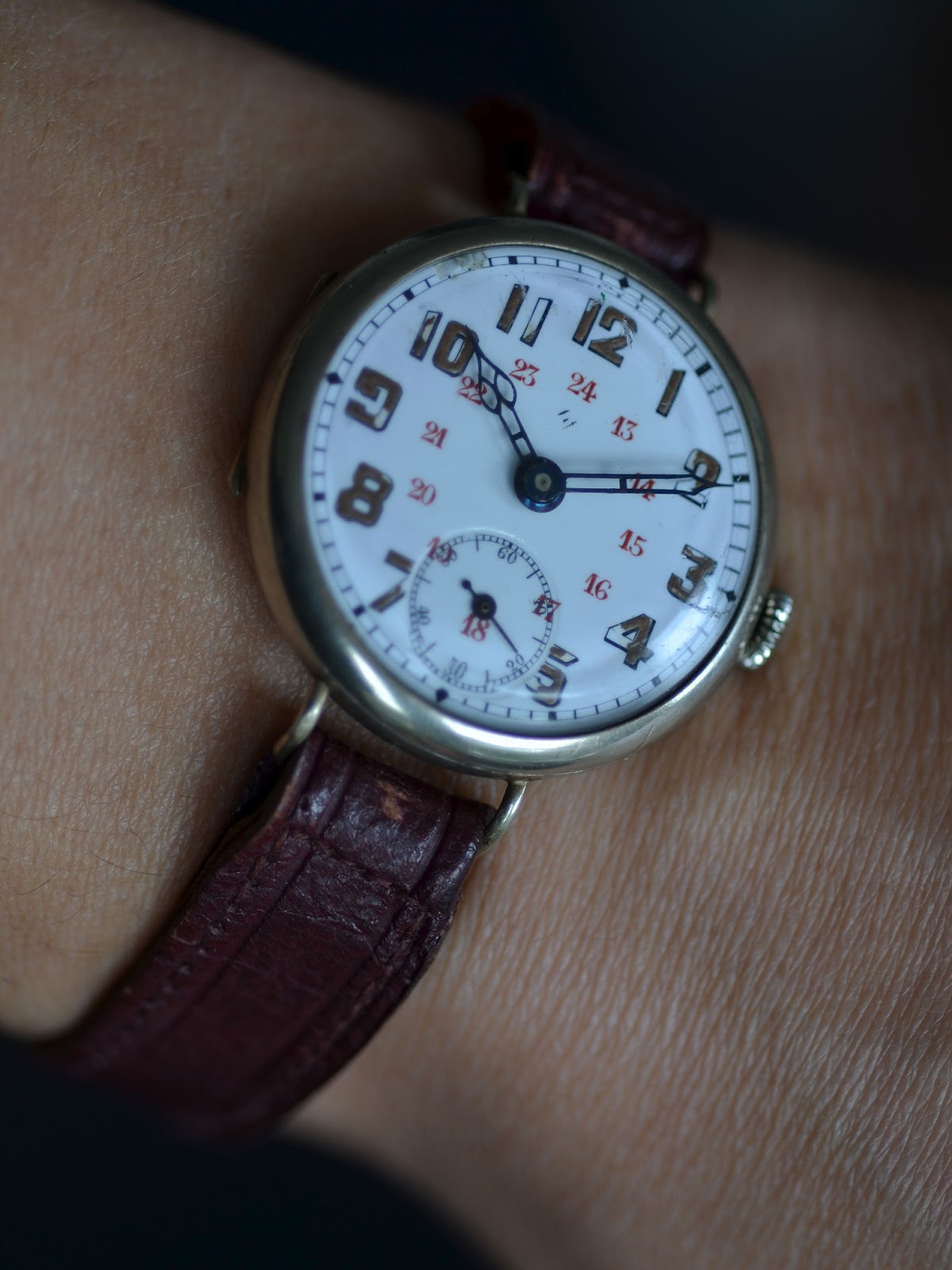
This watch came from ebay in France, although it is not hallmarked (as would be a silver watch sold in England from this period), so we cannot date it exactly, however I am confident it derives from the first world war. It bears signs of being for military use: it has an (overprinted) 24 hour dial and you can see the remnants of the radium lume that allowed the time to be read in the dark. The style of the movement and the porcelain dial further serve to place it to within the first 30 years of the 20th century.

I was drawn to this particular watch as an archetype of the early, military watch. The size of the watch is slightly smaller than would generally be considered a man's watch these days at 32mm, but it sits nicely on the wrist.  


What I did (with some help) to repair the watch:

I should say at the start that I'm not trying to provide technical instruction here - it's more a record of what we did to get the watch back to life and I have omitted some stages. The watch was not working when I received it, and indeed it had lost the winding stem and crown. I purchased a mixed lot of winding stems (from here) and managed to find one that fitted (it was the second one that I tried, so I got very lucky!).

I disassembled the watch completely (this part is generally quite straightforward). You can see (almost) all the parts laid out in the photo above, this sequence represents the third time I'd reassembled the watch and for expediency I left the mainspring inside the mainspring barrel (middle row, extreme left) and also the balance spring attached to the balance cock (top row, the lower piece to the left of the dial). 

  
I cleaned it in a rotary cleaning machine: you load the parts into a little metal basket and then spin them for several minutes in the cleaning solutions (I'll get some shots of this for the next watch, so you'll have to imagine this for now if you've never seen one). The parts are then spun dry in a little heater. After this the jewel holes are "pegged out" this basically means you twiddle a little stick inside them to remove any dried on oil residue that the cleaning machine didn't shift.

After cleaning I reassembled and oiled the watch. The watch has a tiny amount of oil applied to the jewel holes where the pivots of the wheels rotate (the jewels are synthetic rubies, so not of any value!). The oil is applied when the watch is assembled - a single, very small drop of oil is applied with a flat piece of metal called an oiler. You aim the drop of oil at the gap between the wheel pivot and the edge of the jewel and capillary action draws the oil into place. The oil then forms a thin layer that allows the pivot to rotate freely within the hole. The pivots are specially shaped to prevent the oil simply running away and dispersing through the watch.


The first time I assembled the watch, it all worked fine however there was a problem with the mainspring inside the barrel: when you wound the watch up the mainspring would not catch at the end of it's winding (basically it was loose inside of the barrel). This meant that the watch couldn't be fully wound. My tutor Richard helped me put a new bend in the end of the winding spring, you can see this in the photo. This hook allows the spring to catch onto a little protrusion inside the mainspring barrel, the second photo shows the spring wound into the barrel, Richard has an oiler in his right hand and (I guess) has just applied some grease to the coils of the mainspring before closing the barrel. 

 
Once assembled and oiled I hooked the watch up to a timing machine that acoustically processes the "tick-tock" noise to judge how well the watch is keeping time. By adjusting the regulator needle on the balance I managed to get this watch to the the point where it was +-12 seconds per day which is considered excellent performance for a watch of this age and quality of manufacture (this was not an especially expensive watch when new).  


I've worn the watch out and about several times, it runs very well and should be good for plenty more years of service. 


Date: around WWI (1914 - 18)
Movement size: 12 ligne (27.07mm)
Watch size: 33mm diameter
Jewels: 15
Made in: possibly France or Switzerland
Features: stem wind and set / sub seconds at 6 o'clock / 24 hour markings on dial


The movement is nicely finished under the dial (this type of finish is called perlage). This is a side of the movement that would never ben seen by the customer, so shows that there was some pride in the overall quality the movement.

On the dial side there is a Swiss patent number 51482, which relates to the crown mechanism without setting lever spring. Patent filed 05-03-1910 by Fontainemelon Horlogerie, CH (FHF)